Build the skills to lead construction projects from the first estimate to the final walkthrough with a construction management degree from King’s College located in Wilkes-Barre, Pa. This career-focused program combines construction knowledge with engineering, business and leadership to prepare you to coordinate people, materials, schedules, budgets, contracts, safety and quality across every stage of a project.
Students learn how the built environment comes together through classroom instruction, laboratory work, field-based experiences, and collaborative projects. The Bachelor of Construction Management curriculum develops the technical and managerial expertise needed to make informed decisions, solve problems, and guide projects responsibly from preconstruction through completion and commissioning.
Grounded in the mission of King’s College, the program also emphasizes ethical leadership, effective communication, lifelong learning and service to the common good. Graduates will be prepared not only to manage complex work, but also to understand how construction decisions affect clients, workers, communities, and the environment.

What can you do with a degree in construction management?
Construction management professionals help turn plans into finished projects. They work with owners, architects, engineers, contractors, subcontractors, suppliers and public agencies to keep projects moving safely, efficiently and within scope. Graduates may pursue opportunities with general contractors, specialty contractors, construction management firms, developers, design-build firms, government agencies and facilities organizations.
Entry-Level Opportunities
Project engineer or field engineer
Assistant project manager
Estimator or preconstruction assistant
Scheduler or planning assistant
Assistant superintendent or superintendent-in-training
BIM or virtual design and construction (VDC) coordinator
Quality control or safety specialist
With experience, professionals may advance to project manager, construction manager, superintendent, senior estimator, operations manager or regional director. The construction management degree may also support careers in owner’s representation, real estate development, business development, facilities management and asset management.
Graduates may also pursue advanced study in construction management, business administration, civil engineering or real estate, as well as professional credentials for which they meet the applicable education and experience requirements.
According to the U.S. Bureau of Labor Statistics, employment of construction managers is projected to grow 9% from 2024 to 2034, much faster than the average for all occupations, with approximately 46,800 openings expected annually. The median annual salary was $106,980 in May 2024, with reported earnings ranging from less than $65,160 for the lowest 10% to more than $176,990 for the highest 10%.

Why study construction management at King’s?
An interdisciplinary curriculum that blends project management, civil engineering, science, mathematics and business
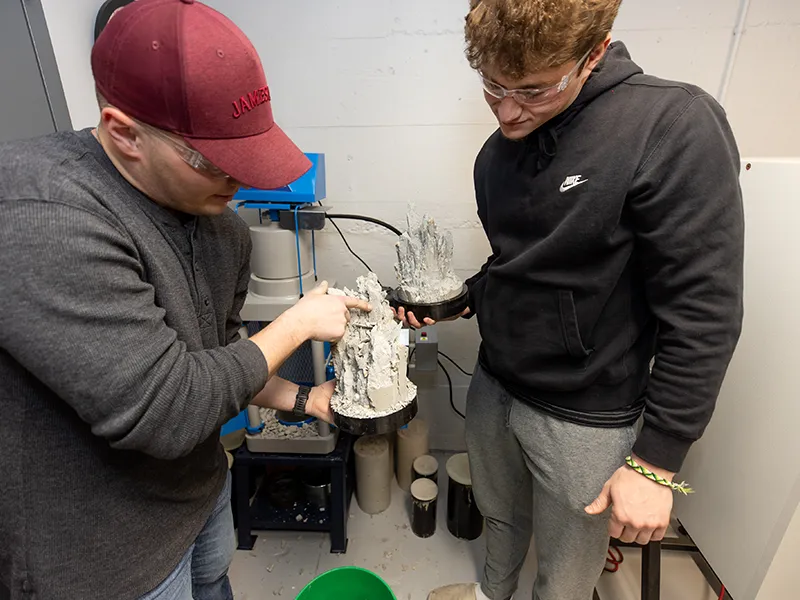
Hands-on learning in surveying, materials testing, structural systems and construction technology
Experience with industry tools and software used for spreadsheets, CAD, GIS, estimating, scheduling and Building Information Modeling (BIM)
Focused coursework in estimating, cost control, safety, risk management, construction law, sustainability and project delivery
A senior capstone that brings estimates, schedules, bids, safety considerations and project planning together in one comprehensive experience
Access to the Mulligan Center for Engineering, with classrooms, laboratories and computing resources that support applied learning
Personal attention, academic advising, tutoring, career planning and internship coordination
Construction Management Details
The Bachelor of Science in Construction Management is a 125-credit program that integrates the King’s College Core with mathematics, science, engineering, business and construction management coursework. Unlike construction management programs that concentrate primarily on architecture or business, the King’s curriculum is intentionally balanced to provide a strong technical foundation alongside the leadership and operational knowledge required to manage projects.
Students begin with introductory construction management, computer applications, surveying and engineering seminar coursework. As they progress, they study construction materials, architecture, law and contracts, estimating and cost control, project management and engineering economics, safety, risk, transportation infrastructure, structural design, construction technology and sustainable practices.
What You Will Learn
Project planning and delivery: understand how construction projects move from predesign and estimating through scheduling, execution, closeout and commissioning.
Estimating and financial control: interpret drawings, perform quantity takeoffs, prepare estimates and monitor budgets, costs, and forecasts.
Safety and risk management: recognize hazards, evaluate project risks, understand regulatory responsibilities, and develop a construction project safety plan.
Materials and construction methods: study soils, asphalt, concrete, sitework, field inspection, quality management and constructability through coursework and laboratory experiences.
Structures and building systems: develop an understanding of structural behavior, load paths, construction sequencing and the fundamentals of HVAC, electrical and plumbing systems.
Technology and data: apply spreadsheets, CAD, GIS, estimating and scheduling software, BIM, and other electronic tools to manage the construction process.
Contracts, law and ethics: examine project delivery methods, contract administration, dispute resolution, regulatory compliance and ethical professional decision-making.
Sustainable construction: explore sustainable materials, waste reduction, lifecycle assessment and approaches that reduce the environmental and social impacts of construction.
Leadership and communication: communicate with a range of audiences, contribute effectively to teams, plan work, meet deadlines, and manage labor and resources.
Hands-On Learning
Applied learning is built throughout the program. Students use surveying tools for construction layout and control, work with construction and engineering materials in laboratory settings, interpret drawings and geotechnical information, and apply digital tools to real project-management tasks. Coursework connects technical decisions to cost, schedule, quality, safety, and sustainability; the factors construction managers balance every day.
In the senior capstone, students draw on knowledge developed across the curriculum to complete a comprehensive project. Working individually and in teams, they may prepare project plans, estimates, schedules, bids, reports and presentations while addressing technical, financial, legal, ethical and environmental considerations.
Featured Areas of Study
Introduction to Construction Management
Surveying with Laboratory
Computer Applications for Construction Management
Introduction to Architecture
Construction Law and Contracts
Estimating and Cost Control
Construction Safety, including OSHA 30-hour Construction Safety training
Coursework aligned with professional certification exams, such as Associate Constructor (AIC) and LEED Green Associate (LEED GA)
Risk Management
Construction Materials with Laboratory
Project Management and Engineering Economics
Transportation Infrastructure
Construction Technology and BIM
Sustainable Construction Practices
Structural Design for Construction Management with Laboratory
Senior Capstone
Student Learning Outcomes
The curriculum is designed to prepare graduates to manage construction projects with attention to scope, schedule, budget, quality, safety, and sustainability. By completing the program, students will be prepared to:
Identify and solve technical problems using mathematics, science and construction-specific knowledge
Design or improve systems, processes and procedures for an intended purpose
Conduct tests or experiments, analyze data and use sound judgment to draw conclusions
Communicate effectively in writing, presentations and professional settings
Apply ethical and professional responsibilities while considering economic, environmental and societal impacts
Work effectively on teams that establish goals, plan tasks, meet deadlines and evaluate risk and uncertainty
Develop cost estimates, schedules, safety plans and project-control strategies
Use surveying methods and electronic technology to support construction operations
Understand construction law, project delivery, quality control, structural behavior, building systems and sustainable practices
Program Accreditation
King’s College has designed the Bachelor of Science in Construction Management curriculum to align with the student outcomes and construction-specific knowledge areas established by the Applied and Natural Science Accreditation Commission (ANSAC) of ABET and with curriculum standards established by the American Council for Construction Education (ACCE). This program builds on the engineering department's strong academic foundation, where both the Civil Engineering and Mechanical Engineering programs are accredited by the Engineering Accreditation Commission of ABET.
Because new programs cannot seek ABET accreditation until they meet eligibility requirements that include graduating an initial class, the King’s construction management program is not currently ABET accredited. King’s plans to pursue ABET-ANSAC and ACCE accreditation when the program becomes eligible. Accreditation is not guaranteed and is awarded only after the respective organizations complete their required reviews.
We welcome all potential students and their families to visit our beautiful campus and get a taste of the King’s College experience. Feel free to schedule a personal visit or register for one of our upcoming admission events.